

A free, self-hosted AI studio with 200+ unfiltered
Open Sourceaivideoimageself-hosted
Free
Video & Animation
cognee is an open-source AI memory platform designed to provide agents with persistent, long-term memory through a self-hosted knowledge graph engine. In an era where AI applications—from chatbots to autonomous agents—increasingly need to remember past interactions and context, cognee fills a critical gap by enabling robust, scalable, and privacy-respecting memory that persists across sessions.
At its core, cognee is a Python library that integrates easily into existing AI pipelines. It creates and manages a knowledge graph that stores entities, relationships, and contextual information extracted from conversations or data sources. Unlike ephemeral vector stores that may lose nuance, knowledge graphs capture complex, interconnected relationships, allowing agents to recall detailed histories, user preferences, and factual knowledge with high fidelity. This makes it ideal for applications like personal assistants that need to remember appointments and habits, chatbots that must maintain coherent multi-turn dialogs, or retrieval-augmented generation (RAG) systems that benefit from a persistent memory layer.
One of cognee’s standout strengths is its self-hosted architecture. By running entirely on your own infrastructure, it guarantees full data privacy and control—no data ever leaves your environment. This is a significant advantage for enterprises and developers handling sensitive information who cannot rely on cloud-based memory services. Additionally, being open-source (with over 28.5k GitHub stars) means there’s active community support, transparency, and the freedom to customize the engine to specific needs. The library is scalable and designed with a privacy-first philosophy, making it suitable for everything from hobby projects to production systems.
However, cognee is not without its trade-offs. The requirement to self-host means users must deal with setup and maintenance, which can be a barrier for beginners or teams without DevOps expertise. Currently, the library is Python-centric, so integration is straightforward in Python environments but may require extra effort for other languages. Despite these limitations, for developers already working in Python and building memory-intensive AI agents, cognee offers a powerful, free, and flexible solution.
In summary, cognee empowers developers to build smarter, more context-aware AI systems by providing a persistent, graph-based memory that lives on your own servers. Its combination of open-source accessibility, privacy, and knowledge graph capabilities positions it as a compelling alternative to cloud-dependent memory solutions.
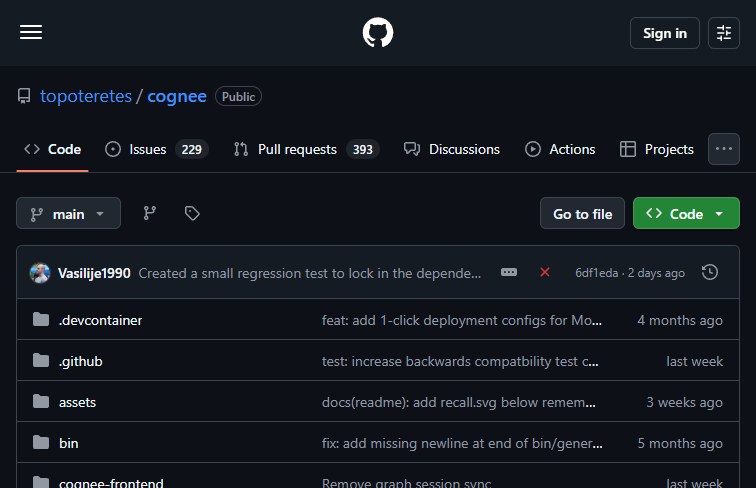 Screenshot
Completely free and open-source under a permissive license.
Summarized from the official site: https://github.com/topoteretes/cognee
Yes, cognee is a free, open-source AI memory platform with over 28.5k GitHub stars. Being open-source means it offers active community support, transparency, and the freedom to customize the engine to your specific needs.
Cognee is an open-source Python library that provides AI agents with persistent, long-term memory through a self-hosted knowledge graph engine. It stores entities, relationships, and contextual information to allow applications like chatbots and personal assistants to recall detailed histories and complex relationships.
Yes, cognee guarantees full data privacy and control because it runs entirely on your own infrastructure. No data ever leaves your environment, making it a significant advantage for teams handling sensitive information who cannot use cloud-based memory services.
Currently, cognee is a Python-centric library, meaning integration is straightforward in Python environments but may require extra effort for other languages. Developers using other programming languages should be prepared for additional setup work.
Cognee is ideal for building chatbots that maintain coherent multi-turn dialogs and personal assistants that remember daily tasks. It is also highly beneficial for retrieval-augmented generation (RAG) systems that need a persistent memory layer.
A free, self-hosted AI studio with 200+ unfiltered

Optimize and secure AI coding agents with this ope

Objective, community-driven leaderboard for text-t

Generate highly realistic AI images from text with