
A free, self-hosted AI studio with 200+ unfiltered
Open Sourceaivideoimageself-hosted
Free
Video & Animation
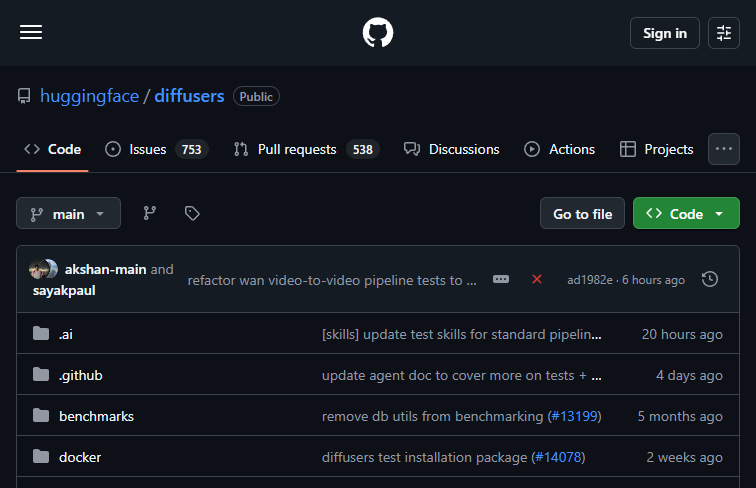
Diffusers is a widely adopted open-source library from Hugging Face that provides a unified interface for working with state-of-the-art diffusion models. Written in Python and available on GitHub, it has garnered over 34,000 stars, reflecting its pivotal role in democratizing generative AI for image, video, and audio synthesis. The library abstracts away much of the complexity involved in running and customizing diffusion models, offering prebuilt pipelines for common tasks such as text-to-image generation, image variation, inpainting, and super-resolution. This makes it accessible to both researchers prototyping novel ideas and developers seeking to integrate generative capabilities into applications without deep expertise in the underlying mathematics.
At its heart, diffusers is built around a modular architecture that decouples models, schedulers, and pipelines. Users can easily swap components—for example, experimenting with different noise schedulers like DDPM, DDIM, or PNDM—to trade off speed and quality. The library comes with an extensive collection of pretrained weights, including Stable Diffusion variants, Kandinsky, and even DALL·E models, all downloadable from the Hugging Face Hub with a single line of code. This hub integration not only simplifies distribution but also fosters a vibrant ecosystem where the community shares fine-tuned models for specific styles or domains. For those looking to push boundaries, diffusers supports training scripts and examples, enabling users to fine-tune models on custom datasets, although this demands substantial GPU resources.
The typical workflow involves loading a pipeline, which chains together a text encoder, a diffusion model, and a scheduler. For text-to-image, you provide a prompt, and the pipeline handles the iterative denoising process that transforms random noise into a coherent image. Image-to-image and inpainting pipelines add the ability to condition generation on existing visuals, making it a versatile tool for creative editing. More recently, the library has expanded beyond images to include experimental support for video and audio generation, signaling its ambition to cover multi-modal generative needs.
One of diffusers’ greatest strengths is its active maintenance and alignment with the fast-paced research field. New architectures and techniques are quickly incorporated, often days after a paper’s release. The documentation is detailed, with numerous tutorials and example notebooks that lower the barrier to entry. However, beginners may still face a learning curve, as understanding concepts like latents, schedulers, and guidance scales requires some background. Additionally, while inference can run on consumer GPUs, generating high-resolution images or training models demands significant computational power, which may be costly.
In summary, diffusers is an indispensable toolkit for anyone working with diffusion models, from hobbyists creating AI art to enterprises building production pipelines. Its flexibility, rich model zoo, and seamless Hugging Face ecosystem make it a top choice despite the hardware demands. Whether you are generating illustrations, restoring old photos, or exploring the frontiers of generative media, diffusers provides a robust and continuously evolving foundation.
 Screenshot
The library is open-source and completely free to use under the Apache 2.0 license.
Summarized from the official site: https://github.com/huggingface/diffusers
Yes, diffusers is an open-source library available on GitHub. It is developed by Hugging Face and has garnered over 34,000 stars.
Diffusers is a Python library that provides a unified interface for working with state-of-the-art diffusion models. It abstracts away complexity to make generative AI for image, video, and audio synthesis accessible to both researchers and developers.
Yes, the library recently expanded to include experimental support for video and audio generation. This is in addition to its core capabilities for various image generation and editing tasks.
Yes, diffusers provides training scripts and examples that enable users to fine-tune models on custom datasets. However, you should be aware that this demands substantial GPU resources.
A free, self-hosted AI studio with 200+ unfiltered

Optimize and secure AI coding agents with this ope

Objective, community-driven leaderboard for text-t

Generate highly realistic AI images from text with