

A free, self-hosted AI studio with 200+ unfiltered
Open Sourceaivideoimageself-hosted
Free
Video & Animation
ktransformers is an open-source Python framework designed to streamline the process of working with large language models (LLMs) across diverse hardware environments. Developed by the team behind the popular kvcache-ai project and hosted on GitHub with over 18,500 stars, it has quickly become a go-to tool for developers and researchers aiming to extract maximum performance from LLM inference and fine-tuning tasks. The framework's standout feature is its heterogeneous inference support, which allows users to seamlessly run models on a mix of GPUs, CPUs, and other hardware backends without rewriting core code. This is achieved through a flexible configuration system that abstracts away hardware-specific details, letting practitioners focus on model optimization rather than low-level engineering.
At its core, ktransformers leverages built-in optimizations for common LLM operations such as attention mechanisms and memory management, making it easier to fine-tune models on custom datasets. It integrates with popular libraries like Hugging Face Transformers and PyTorch, so users can often plug it into existing workflows with minimal friction. The extensible architecture encourages experimentation, whether you're benchmarking different quantization schemes, exploring model parallelism strategies, or testing novel inference runtimes. For researchers, this means a unified platform for reproducible performance comparisons across hardware setups; for developers, it reduces the time spent tuning models for production deployment. Typical use cases include running Llama-2 on a mix of cloud GPUs and local CPUs, or fine-tuning a chat model with LoRA on a single GPU while offloading gradient checkpoints to system RAM to save VRAM.
However, ktransformers is not a turnkey solution for beginners. Setting up heterogeneous inference requires a solid understanding of LLM internals and hardware constraints, and the documentation, while growing, may not yet cover all edge cases. The project is under active development, so users should be comfortable with reading source code and engaging with the community to troubleshoot issues. Despite these challenges, the vibrant community and frequent updates make it a promising choice for those willing to invest the time. With over 18k stars on GitHub, it's clear that the community trusts and extends this framework, making it a safe bet for forward-looking ML engineering.
In summary, ktransformers fills a crucial gap for anyone who needs to optimize LLMs for varied hardware without being locked into a single vendor's ecosystem. Its flexibility, performance gains, and strong community support position it as a valuable asset in the modern AI toolkit.
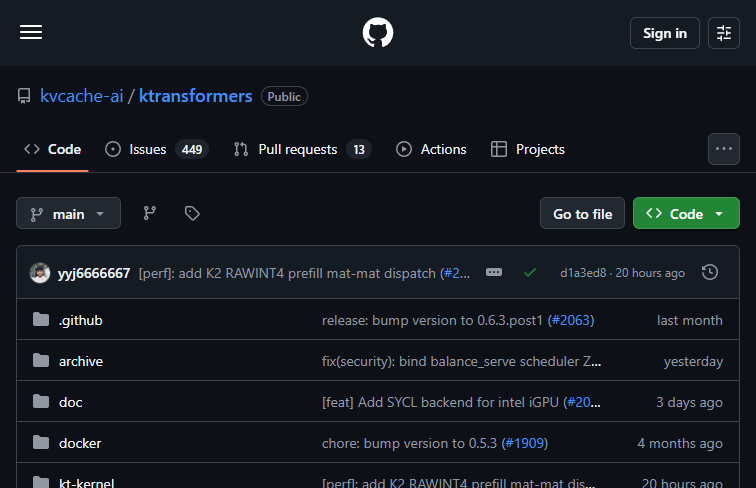 Screenshot
The project is free and open-source under the MIT license.
Summarized from the official site: https://github.com/kvcache-ai/ktransformers
Yes, ktransformers is an open-source Python framework hosted on GitHub with over 18,500 stars.
ktransformers is a Python framework designed to optimize large language model (LLM) inference and fine-tuning across diverse hardware environments. It features heterogeneous inference support, allowing users to run models on a mix of GPUs, CPUs, and other hardware without rewriting core code.
No, it is not a turnkey solution for beginners. Setting it up requires a solid understanding of LLM internals and hardware constraints, and users should be comfortable reading source code to troubleshoot issues.
Yes, ktransformers seamlessly integrates with popular libraries like Hugging Face Transformers and PyTorch. This allows users to easily plug it into their existing workflows with minimal friction.
Yes, ktransformers supports heterogeneous inference, allowing you to run and optimize models across a mix of CPUs, GPUs, and other hardware backends. This enables use cases like running models on local CPUs while offloading tasks to cloud GPUs.
A free, self-hosted AI studio with 200+ unfiltered

Optimize and secure AI coding agents with this ope

Objective, community-driven leaderboard for text-t

Generate highly realistic AI images from text with