
A free, self-hosted AI studio with 200+ unfiltered
Open Sourceaivideoimageself-hosted
Free
Video & Animation
Mochi 1, recently unveiled by Genmo, is making significant waves in the digital creative space as a new state-of-the-art (SOTA) open-source video generation model. For a long time, the AI video generation sector has been heavily dominated by closed-source, proprietary platforms that restrict user access and customization. Mochi 1 actively disrupts this dynamic by offering its cutting-edge capabilities under the highly permissive Apache 2.0 license. At its core, Mochi 1 is designed to translate detailed text prompts into high-fidelity, fluid video output. It represents a massive leap forward for accessible, high-quality AI media generation. By providing available weights for direct download, Genmo empowers developers and creators with the unprecedented freedom of local deployment, an incredibly rare offering in the SOTA video landscape.
So, who exactly is this advanced tool built for? Primarily, Mochi 1 targets an audience of AI researchers, software developers, and highly technical digital artists. For researchers focused on open-source diffusion models, Mochi 1 provides a transparent, modifiable framework to study and experiment with next-generation video architecture. Furthermore, software developers looking to integrate complex, high-quality video generation capabilities directly into their own custom applications can now do so without the restrictive API limits or exorbitant recurring subscription costs typically associated with proprietary models. Finally, digital marketers and media creators who have the necessary hardware infrastructure can leverage this robust tool to generate bespoke visual content entirely in-house, ensuring maximum creative control and data privacy.
In terms of how it works, Mochi 1 utilizes sophisticated diffusion-based architecture to synthesize high-fidelity video sequences directly from natural language inputs. The process involves navigating intricate latent spaces to render temporally coherent and visually striking frames. However, a critical operational caveat is the hardware requirement. Because it is currently available as a preview version and pushes the absolute boundaries of open-source video fidelity, running Mochi 1 locally demands substantial computational resources. Users will likely need high-end GPUs to execute the model effectively and render videos in a timely manner.
The pros of Mochi 1 are undeniably compelling. It is fully open-source, backed by the reputable team at Genmo, and genuinely challenges proprietary ecosystems with its claimed state-of-the-art output quality. The primary cons are largely logistical: it remains an early preview, and the sheer computational cost of running it locally may act as a barrier to entry for hobbyists or creators lacking enterprise-grade hardware. Ultimately, Mochi 1 is a monumental release that sets a thrilling new benchmark for the future of the open-source AI video community.
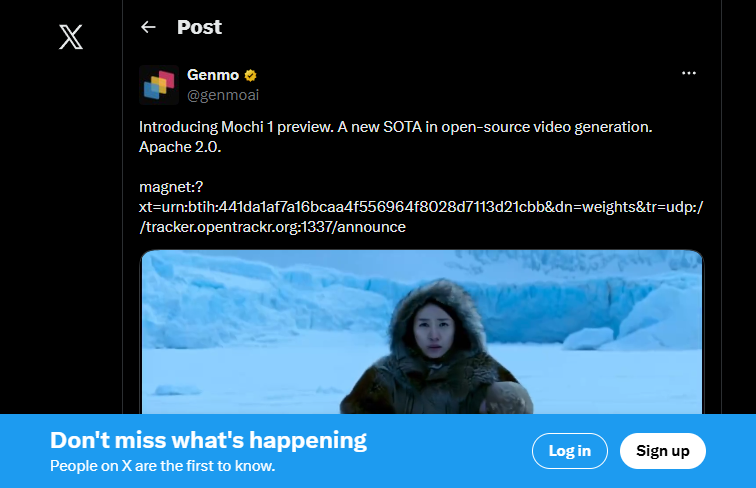 Screenshot
The model is completely free and open-source under the Apache 2.0 license.
Summarized from the official site: https://twitter.com/genmoai/status/1848762405779574990
Yes, Mochi 1 is a state-of-the-art open-source video generation model released by Genmo. It is available under the highly permissive Apache 2.0 license, which actively disrupts the restrictive dynamic of proprietary platforms.
Yes, Genmo provides the available weights for direct download, giving you the unprecedented freedom of local deployment. However, running it locally demands substantial computational resources, meaning you will likely need high-end GPUs to execute the model effectively.
Yes, developers can download and run Mochi 1 locally without the restrictive API limits or exorbitant recurring subscription costs typically associated with proprietary models. This allows you to integrate complex video generation capabilities directly into your own custom applications.
Yes, the sheer computational cost of running Mochi 1 locally may act as a barrier to entry for hobbyists or creators lacking enterprise-grade hardware. Because it pushes the absolute boundaries of open-source video fidelity, users will need high-end GPUs to render videos in a timely manner.
A free, self-hosted AI studio with 200+ unfiltered

Objective, community-driven leaderboard for text-t

Optimize and secure AI coding agents with this ope

Generate highly realistic AI images from text with