

A free, self-hosted AI studio with 200+ unfiltered
Open Sourceaivideoimageself-hosted
Free
Video & Animation
For developers and researchers looking to experiment with large language models safely and efficiently, Monadic Chat presents a compelling, infrastructure-focused solution. As the landscape of AI conversational agents rapidly expands, managing the execution environment of these models becomes just as critical as the models themselves. Monadic Chat addresses this by providing a robust, Docker-based framework specifically designed for AI interaction and secure environment execution. At its core, the tool leverages containerization to create isolated environments where users can run, test, and interact with AI models without risking their host systems. This approach inherently provides a highly secure sandbox, making it an excellent choice for testing experimental code or handling untrusted AI-generated outputs. The platform's architecture is highly portable due to its Docker integration, meaning that once an environment is configured, it can be seamlessly deployed across different machines and operating systems without the notorious dependency conflicts that often plague local AI development. Who is this tool built for? Primarily, it targets software developers, AI researchers, and tech-savvy tinkerers who need a reliable foundation for developing and testing custom AI chat interfaces. It is also highly suited for teams looking to deploy local AI assistants within a strictly controlled infrastructure. By open-sourcing the framework, the creator has removed the financial barrier to entry, allowing anyone to download, inspect, and modify the codebase to suit their specific project needs. However, Monadic Chat is not necessarily a plug-and-play solution for the average non-technical user. The primary barrier to entry is its strict dependency on Docker. Users must possess a working knowledge of Docker installation, container management, and command-line operations to get the framework up and running effectively. While this requirement might steepen the learning curve for coding novices, it is a reasonable expectation for its target audience of seasoned developers. Once the initial Docker setup is complete, users are rewarded with a highly customizable framework that acts as a personal laboratory for conversational AI. Whether you are conducting data analysis with AI agents, building a local assistant to process sensitive corporate documents, or simply researching new chat interface paradigms, Monadic Chat provides the necessary isolated infrastructure. It successfully abstracts the messiness of local environment setup, allowing developers to focus entirely on the conversational logic and model performance. Overall, it stands out as a highly practical, secure, and cost-effective utility in the modern developer toolkit, recently gaining notable traction and positive community feedback on technology forums like Hacker News.
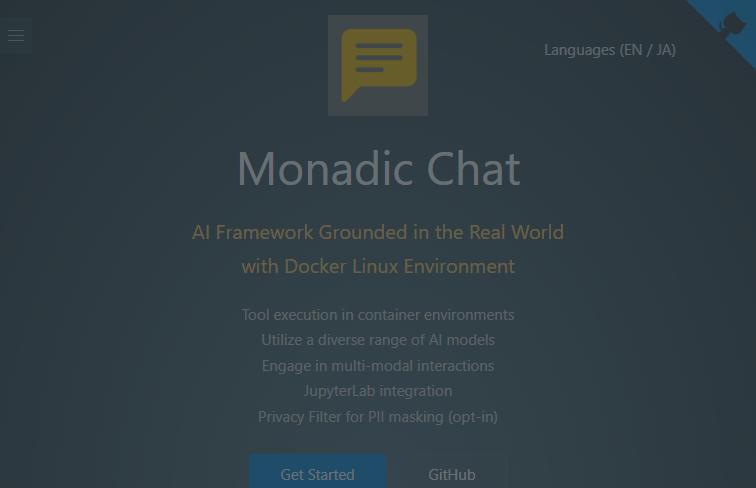 Screenshot
Monadic Chat is an open-source project and is completely free to use.
Summarized from the official site: https://yohasebe.github.io/monadic-chat/
Yes, Monadic Chat is completely free and open-source. The creator removed the financial barrier to entry, allowing anyone to download, inspect, and modify the codebase for their specific project needs.
Yes, using Monadic Chat requires a strict dependency on Docker. Users must possess a working knowledge of Docker installation, container management, and command-line operations to run the framework effectively.
No, it is not a plug-and-play solution for the average non-technical user. Its requirement for Docker and command-line operations steepens the learning curve, making it better suited for seasoned developers and AI researchers.
Monadic Chat is a Docker-based framework used to securely run, test, and interact with large language models. It provides developers and researchers an isolated sandbox environment for testing experimental code or handling untrusted AI-generated outputs without risking host systems.
A free, self-hosted AI studio with 200+ unfiltered

Objective, community-driven leaderboard for text-t

Optimize and secure AI coding agents with this ope

Generate highly realistic AI images from text with