
A free, self-hosted AI studio with 200+ unfiltered
Open Sourceaivideoimageself-hosted
Free
Video & Animation
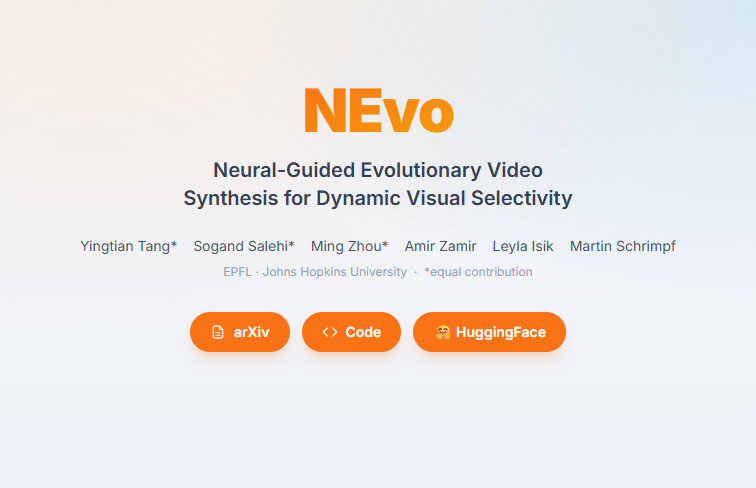
Developed through a groundbreaking collaboration between EPFL and Johns Hopkins University, NEvo represents a fascinating leap forward in the intersection of artificial intelligence and computational neuroscience. Unlike mainstream AI video generators designed for content creation, filmmaking, or marketing, NEvo is a highly specialized research instrument built specifically to advance our understanding of the human brain. It utilizes a sophisticated neural-guided evolutionary video synthesis framework to create dynamic visual stimuli that are uniquely engineered to maximally drive targeted brain regions. At its core, NEvo tackles a complex challenge in neuroscience: figuring out exactly what kind of visual input will activate specific neural pathways. By integrating seamlessly with existing computational neuroscience models, the AI generates dynamic videos designed to test and map visual selectivity. Rather than relying on static images or standard video clips, researchers can use NEvo to synthesize highly controlled, custom dynamic visual stimuli. This allows for an unprecedented level of precision when studying neural responses, as the generated content evolves specifically to interact with the targeted brain area. This tool is an incredible asset for professionals conducting in-depth visual stimulation experiments. Its primary use cases revolve around mapping visual selectivity in the brain and generating the exact visual parameters needed to elicit specific neural responses. Furthermore, the implications of this technology extend deeply into the realm of medical and technological advancement, particularly in advancing brain-computer interface (BCI) research through precisely controlled visual stimulation. One of the most commendable aspects of NEvo is its open-source availability, reflecting an academic commitment to democratizing advanced research tools. Developed by leading academic institutions, it provides a robust, transparent framework for the global scientific community. However, it is crucial to note that NEvo is not a tool for the average consumer or general creator. Its highly specialized nature means it is exclusively intended for neuroscience researchers, computational biologists, and cognitive scientists who possess the technical background required to utilize computational models and interpret complex neural data. For that specific scientific audience, NEvo is an invaluable, innovative leap that bridges the gap between AI video generation and practical brain research, opening entirely new avenues for exploring the complexities of visual processing.
 Screenshot
The project appears to be a free, open-source research initiative without any commercial pricing.
Summarized from the official site: https://nevo-project.epfl.ch/
NEvo is a neural-guided evolutionary video synthesis tool designed to generate dynamic videos that maximally drive a target brain region. It was developed as a research collaboration between EPFL and Johns Hopkins University.
Yes, NEvo appears to be an open-source research project. It provides public access to its codebase and arXiv paper for researchers.
NEvo was developed by researchers from EPFL and Johns Hopkins University. Key contributors include Yingtian Tang, Sogand Salehi, Ming Zhou, Amir Zamir, Leyla Isik, and Martin Schrimpf.
Yes, as an open-source academic research project, NEvo is freely accessible. There are no commercial pricing plans mentioned.
A free, self-hosted AI studio with 200+ unfiltered

Objective, community-driven leaderboard for text-t

Advanced AI video generation for high-fidelity, st

Auto-generate Netflix-quality subtitles and dubbing with AI.