
A free, self-hosted AI studio with 200+ unfiltered
Open Sourceaivideoimageself-hosted
Free
Video & Animation
OpenMontage is an ambitious open-source project that aims to revolutionize video production by combining automation, modular tooling, and AI agent capabilities into a single, extensible system. Positioned as the world’s first open-source, agentic video production platform, it offers a comprehensive suite of 12 end-to-end pipelines, 52 integrated tools, and over 500 specialized agent skills, enabling users to automate everything from simple cuts to complex narrative-driven videos. Designed primarily for developers, technical content creators, and teams who manage high-volume video workflows, OpenMontage transforms how video projects are conceived and executed by allowing users to leverage AI coding assistants as the orchestrators of the entire production process. Instead of manually clicking through timelines, users can describe what they need—such as “create a 30-second product teaser with text overlays and background music”—and the system’s agents will reason over the available tools and pipelines to generate the requested output, reducing hours of repetitive work to just a few commands.
The core of OpenMontage lies in its modular architecture. The 12 production pipelines serve as pre-built workflows for common scenarios like social media clip generation, educational content creation, or marketing video assembly. Each pipeline chains together multiple tools that handle specific tasks: from transcription and subtitle generation to scene detection, color grading, and audio mixing. The 500+ agent skills act as high-level cognitive building blocks, allowing the system to understand context, maintain narrative coherence, and make creative decisions that would normally require human intervention. Because the entire system is open-source and written in Python, it can be self-hosted, customized, and extended to fit niche requirements, making it a flexible foundation for building proprietary video automation stacks. The seamless integration with AI coding assistants means that users can interact with OpenMontage using natural language inside their development environments, turning tools like GitHub Copilot or custom LLM agents into video producers that can call the system’s API functions directly.
This tool is particularly well-suited for developers who need to generate large volumes of video content programmatically—think startups producing hundreds of personalized marketing clips, educators building lesson visuals at scale, or media teams automating routine editing tasks. However, it’s not a one-click solution for casual users. Deploying OpenMontage requires a certain level of technical proficiency: you’ll need to set up a Python environment, manage dependencies, and possibly configure cloud compute resources if you want to offload heavy processing. The lack of a polished graphical interface means the primary interaction is through code or AI assistants, which can present a steep learning curve for non-developers. That said, the project’s 40,000+ GitHub stars and active community attest to its potential and growing adoption.
In summary, OpenMontage is a powerful, agentic video production system that brings the flexibility and cost-effectiveness of open-source software to a domain typically dominated by expensive, closed-source tools. It empowers developers and technically inclined creators to build sophisticated video workflows that can adapt to their exact needs, all while benefiting from the rapid innovation happening in AI-assisted development. For those willing to invest the setup time, it offers a glimpse into the future of automated content creation—one where your IDE can double as a full-fledged video studio.
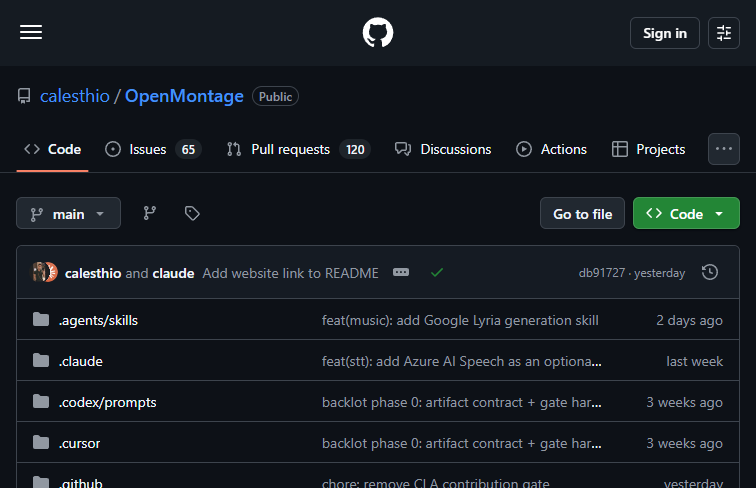 Screenshot
 image
image
 image
image
 image
image
Open-source and free to use, self-hosted.
Summarized from the official site: https://github.com/calesthio/OpenMontage
Yes, OpenMontage is an open-source project. It is written in Python, allowing users to self-host, customize, and extend the system to build their own proprietary video automation stacks.
No, the platform has a steep learning curve for non-developers and lacks a polished graphical user interface. Users need technical proficiency to set up a Python environment, manage dependencies, and interact with the system primarily through code or AI coding assistants.
It is designed primarily for developers, technical content creators, and teams managing high-volume video workflows. Examples of target users include startups producing personalized marketing clips, educators building lesson visuals at scale, or media teams automating routine editing tasks.
Yes, the system seamlessly integrates with AI coding assistants so you can interact with it using natural language. You can use tools like GitHub Copilot or custom LLM agents to act as video producers by directly calling the system's API functions.
A free, self-hosted AI studio with 200+ unfiltered

Objective, community-driven leaderboard for text-t

Optimize and secure AI coding agents with this ope

Generate highly realistic AI images from text with