
A free, self-hosted AI studio with 200+ unfiltered
Open Sourceaivideoimageself-hosted
Free
Video & Animation

Specification-driven Python framework for autonomous AI agents.
Ouroboros is an open-source Python framework that reimagines how we build autonomous AI agents. Instead of crafting lengthy, ambiguous natural language prompts, developers define tasks through structured specifications. This paradigm shift, encapsulated in the project’s motto “Stop prompting. Start specifying,” aims to reduce misinterpretation and enable agents to execute complex, multi-step workflows without constant human oversight. Hosted on GitHub under the repository Q00/ouroboros, the tool has garnered over 5,000 stars, reflecting a growing community of developers interested in specification-driven automation.
At its core, Ouroboros functions as an “Agent OS” that executes tasks based on predefined specifications. These specifications outline the desired actions, inputs, outputs, and conditions, allowing the agent to operate autonomously. Unlike traditional prompt-based systems where users must iteratively refine instructions, Ouroboros interprets structured directives, making it ideal for automating repetitive yet complex processes. For example, you could specify a workflow to scrape data from multiple sources, transform it, and generate a report—all without writing explicit code for each step. The agent handles the orchestration, calling appropriate tools and APIs as needed.
The framework is built entirely in Python, which lowers the barrier for developers already familiar with the language. Its extensibility means you can integrate custom modules, connect to various APIs, or extend the agent’s capabilities. The open-source nature encourages community contributions, and the active repository suggests ongoing improvements. However, potential users should note that the provided content hints at limited documentation, which could pose challenges for newcomers. Non-developers may find the specification syntax and setup process daunting, as it requires a certain level of technical proficiency.
Who is Ouroboros for? It’s primarily aimed at developers and technical users who need to automate complex, multi-step workflows without constant intervention. It excels in use cases like building self-directed AI assistants that can handle tasks such as scheduling, research, or data processing. Rapid prototyping of agent-based systems is another strong suit—teams can quickly define specifications and test agent behaviors without deep coding. For productivity-focused individuals, the specification-driven approach reduces the need to micromanage AI, potentially saving time and reducing errors.
In practice, Ouroboros shines when tasks have clear, repeatable steps. However, it may be overkill for simple, one-off requests where a traditional prompt suffices. The learning curve, coupled with potentially sparse documentation, means that getting started might require some experimentation or community support. Nonetheless, for those willing to invest the time, Ouroboros offers a powerful new way to harness AI agents, moving away from conversational prompting toward reliable, autonomous execution.
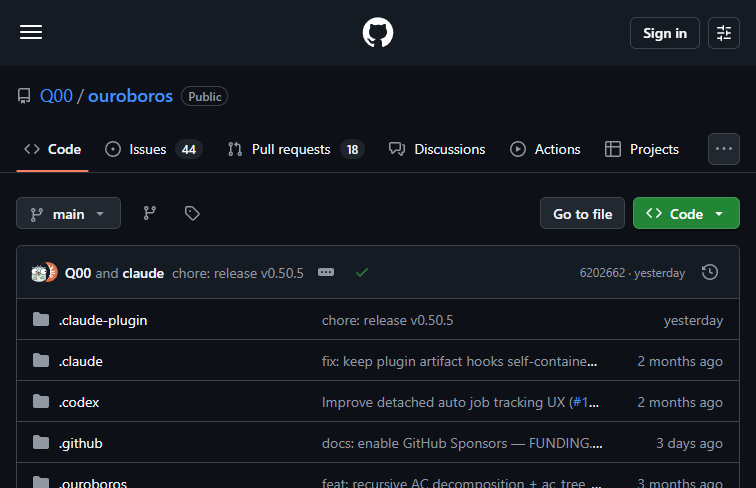 Screenshot
Ouroboros is completely free and open-source under its GitHub license.
Summarized from the official site: https://github.com/Q00/ouroboros
Yes, Ouroboros is an open-source framework hosted on GitHub under the repository Q00/ouroboros. Its open-source nature encourages community contributions and ongoing improvements.
Ouroboros is built entirely in Python. This lowers the barrier to entry for developers already familiar with the language and allows for easy integration of custom modules and APIs.
Ouroboros is primarily aimed at developers and technical users who need to automate complex, multi-step workflows. However, non-developers may find the specification syntax and setup process daunting, as it requires a certain level of technical proficiency.
No, instead of using natural language prompts, you define tasks through structured specifications. Following the motto "Stop prompting. Start specifying," this approach reduces misinterpretation and allows agents to operate autonomously without constant human oversight.
No, Ouroboros may be overkill for simple, one-off requests where a traditional prompt suffices. The framework shines when automating repetitive processes that have clear, repeatable steps.
A free, self-hosted AI studio with 200+ unfiltered

Optimize and secure AI coding agents with this ope

Objective, community-driven leaderboard for text-t

Generate highly realistic AI images from text with