
A free, self-hosted AI studio with 200+ unfiltered
Open Sourceaivideoimageself-hosted
Free
Video & Animation
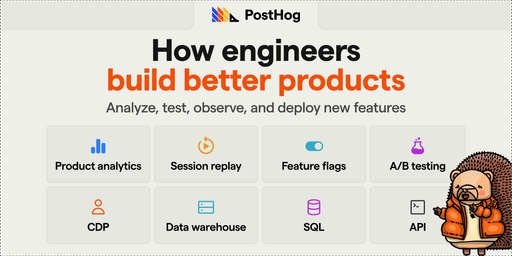
An open-source analytics, debugging, and feature rollout suite for developers.
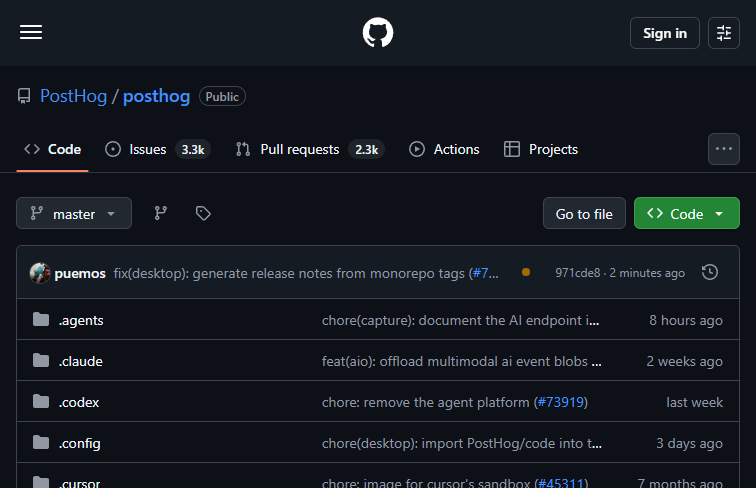
PostHog is an open-source, comprehensive platform designed to help engineering and product teams build, deploy, and refine self-driving products. Built in Python and boasting a massive community of over 37,000 GitHub stars, it serves as an all-in-one toolkit tailored specifically for developers. Rather than piecing together fragmented third-party services for every step of the development lifecycle, teams can utilize PostHog to manage product analytics, monitor application health, and securely roll out new features from a single, centralized hub.
At its core, PostHog excels in providing deep contextual insights into how users interact with an application. One of its standout capabilities is AI observability and analytics, a critical feature for modern teams integrating artificial intelligence into their workflows. Combined with robust session replay functionality, developers can visually trace user journeys and pinpoint exactly where and why an issue occurred. When applications misbehave, PostHog's error tracking and detailed logs capture the necessary telemetry, allowing engineers to diagnose complex problems efficiently without leaving their primary workspace.
Beyond debugging, PostHog heavily empowers data-driven product development. Teams can safely test new ideas and iterate on their user experience using built-in feature flags and A/B experiments. This allows for secure, phased rollouts, ensuring that new updates enhance the product without alienating users or introducing systemic instability. Because it is an open-source platform, organizations retain full control over their deployment and data.
Accessibility and seamless integration are also major strengths of the PostHog ecosystem. Developers are not restricted to a single interface; instead, they can steer their entire product development pipeline through cross-platform access. Whether communicating via Slack, monitoring dashboards on the web or desktop apps, or leveraging the Model Context Protocol (MCP) for deeper programmatic control, PostHog ensures that vital application data is always within reach. This omnichannel approach keeps teams agile and responsive.
While PostHog offers a remarkably comprehensive suite of developer tools, it is important to note its primary audience. The platform is highly technical, meaning that smaller teams without dedicated engineering resources may find that fully deploying and utilizing all of its advanced features requires a steep learning curve and specific technical expertise. However, for engineering-centric organizations looking to unify their analytics, testing, and debugging workflows, PostHog provides an exceptionally powerful, community-backed foundation for continuous product improvement.
 Screenshot
 image
image
 image
image
 image
image
PostHog typically offers a free tier for basic usage and paid plans based on usage volume, though specific pricing details are not provided on the page.
Summarized from the official site: https://github.com/PostHog/posthog
Yes, PostHog is an open-source platform hosted publicly on GitHub with over 37,000 stars.
PostHog is a platform for building self-driving products that provides developer tools like AI observability, analytics, session replay, and error tracking. It helps developers capture context to diagnose problems and ship fixes.
Python is the primary programming language used for PostHog's development.
You can manage PostHog from Slack, the web, desktop applications, or the MCP.
A free, self-hosted AI studio with 200+ unfiltered

Objective, community-driven leaderboard for text-t

Optimize and secure AI coding agents with this ope

Generate highly realistic AI images from text with