
A free, self-hosted AI studio with 200+ unfiltered
Open Sourceaivideoimageself-hosted
Free
Video & Animation
Scikit-learn is a free, open-source machine learning library that has firmly established itself as the cornerstone of the Python data analytics ecosystem. Designed with accessibility and robustness in mind, it provides a comprehensive suite of tools for predictive data analysis, catering to both novices entering the field and seasoned data scientists seeking reliable, standardized solutions. At its core, scikit-learn excels by offering highly optimized algorithms for classification, regression, clustering, and dimensionality reduction. Whether you are forecasting future sales revenue using regression models, predicting customer churn based on historical user data, or grouping e-commerce customers into distinct segments, the library provides the necessary building blocks to execute these standard machine learning tasks with remarkable efficiency. What truly sets scikit-learn apart is how it works seamlessly within the broader Python scientific ecosystem. It integrates perfectly with essential data analytics stacks like NumPy, SciPy, and Pandas, allowing developers to feed manipulated dataframes directly into complex machine learning pipelines. Furthermore, the tool shines in its robust data preprocessing and feature extraction capabilities, ensuring that raw data is correctly normalized and encoded before any modeling begins. To guarantee the validity of your predictive models, scikit-learn includes built-in model selection and cross-validation features, taking the guesswork out of evaluating algorithmic performance. Another major advantage is its highly accessible API design, which remains consistent across different algorithms, making it exceptionally easy to learn and deploy. Backed by a massive, active community, users benefit from unparalleled support, continuous updates, and incredibly rich documentation that provides tutorials for almost every conceivable use case, such as classifying email data as spam or non-spam. However, despite its many strengths, scikit-learn is not without its limitations. It notably lacks built-in support for deep learning and GPU acceleration, meaning it is not the right fit for developing complex neural networks or processing unstructured data like images and natural language at scale. Additionally, because it is designed for single-machine processing, its performance may bottleneck compared to distributed computing frameworks when handling massive, enterprise-level datasets. Despite these limitations, for traditional, tabular data analytics and classical machine learning, scikit-learn remains an unmatched, indispensable powerhouse in the Python programming environment.
 Screenshot
 image
image
scikit-learn is completely free to use as it is an open-source library released under the BSD license.
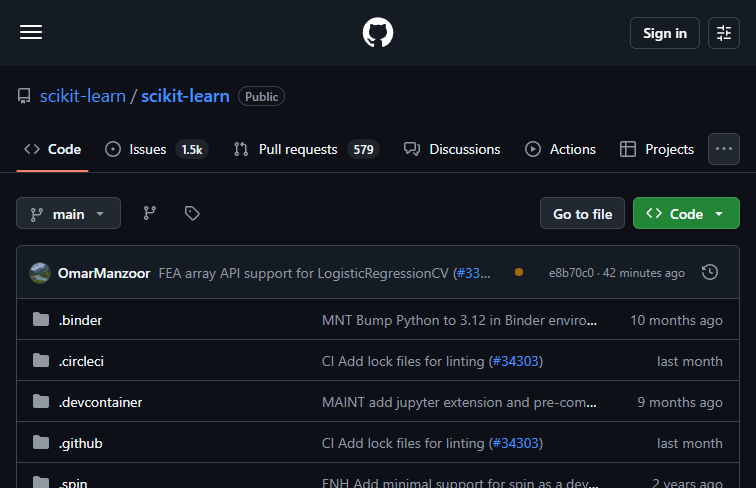
Summarized from the official site: https://github.com/scikit-learn/scikit-learn
Yes, scikit-learn is a completely free, open-source machine learning library. It provides accessible, standardized solutions for both novices and seasoned data scientists.
No, scikit-learn lacks built-in support for deep learning and GPU acceleration. It is not suited for developing complex neural networks or processing unstructured data like images and text at scale.
No, because scikit-learn is designed for single-machine processing, its performance may bottleneck with massive datasets. Distributed computing frameworks are better suited for enterprise-level data.
Yes, it integrates seamlessly with the broader Python scientific ecosystem. You can easily feed manipulated dataframes from libraries like NumPy, SciPy, and Pandas directly into its machine learning pipelines.
A free, self-hosted AI studio with 200+ unfiltered

Optimize and secure AI coding agents with this ope

Objective, community-driven leaderboard for text-t

Generate highly realistic AI images from text with