
A free, self-hosted AI studio with 200+ unfiltered
Open Sourceaivideoimageself-hosted
Free
Video & Animation

Build secure, local voice agents with Hugging Face's open-source S2S.
In an era where cloud-based AI dominates, the Hugging Face Speech-to-Speech project emerges as a powerful, privacy-centric alternative for developers and tech enthusiasts. Hosted on GitHub, this Python-based framework empowers users to build sophisticated local voice agents entirely powered by open-source models. Whether you are looking to create a customized speech-to-speech translation application or an enterprise-grade voice-activated assistant, this repository provides the foundational tools to do so without relying on external servers.
At its core, Hugging Face Speech-to-Speech is designed to leverage the vast ecosystem of open-source audio and language models. By allowing for local execution, it inherently guarantees maximum data privacy—a crucial requirement for businesses handling sensitive information or personal users cautious about their data footprint. Because the processing happens entirely on your own hardware, your voice data never leaves your machine, making it an ideal solution for air-gapped environments or strictly regulated industries.
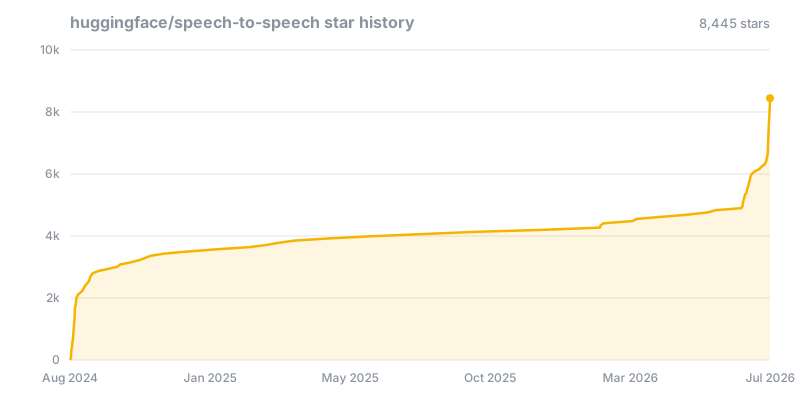
The primary audience for this tool comprises software developers, AI researchers, and tinkerers with a solid understanding of Python. While it is completely free to use, setting it up is not a plug-and-play experience. Users must possess the technical knowledge to navigate a Python-based implementation, manage dependencies, and allocate sufficient compute resources to run the underlying machine learning models effectively. However, this technical barrier to entry is counterbalanced by an incredibly active and vibrant community. Boasting over 9,300 stars on GitHub, the project enjoys high community engagement, meaning that developers have access to robust support, collaborative troubleshooting, and continuous improvements.
Furthermore, being backed by Hugging Face—a highly reputable and pioneering company in the open-source AI space—adds a significant layer of credibility and trust to the project. Users can rest assured that the framework is built on industry-standard architectures and maintained by top-tier experts. In summary, if you possess the necessary coding skills and seek an unrestricted, highly customizable, and secure way to develop voice-activated AI agents, the Hugging Face Speech-to-Speech project is an unparalleled, cost-effective choice in the modern audio-music tech landscape.
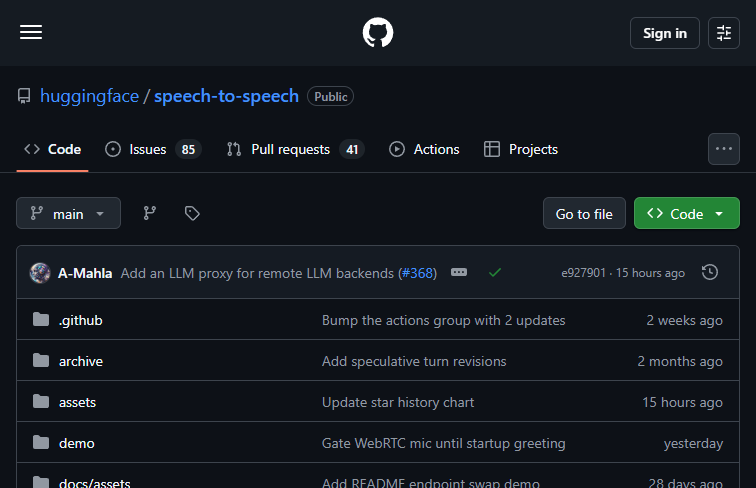 Screenshot
 image
image
 image
image
 image
image
The tool is free to use as it is an open-source project available on GitHub.
Summarized from the official site: https://github.com/huggingface/speech-to-speech
Speech-to-speech is an open-source tool by Hugging Face used to build local voice agents. It is built in Python using open-source models.
Yes, it is completely free to use. It is an open-source project hosted on GitHub.
Yes, speech-to-speech is fully open-source. It is publicly available on Hugging Face's GitHub repository.
Speech-to-speech was developed by Hugging Face. It currently has over 9,300 stars on GitHub.
A free, self-hosted AI studio with 200+ unfiltered

Optimize and secure AI coding agents with this ope

Generate highly realistic AI images from text with

Generate lifelike speech with Google's WaveNet tec