
A free, self-hosted AI studio with 200+ unfiltered
Open Sourceaivideoimageself-hosted
Free
Video & Animation
Run massive 80B LLMs locally on Mac and iPhone using minimal RAM.
In an era where large language models (LLMs) are predominantly locked behind massive cloud clusters and expensive enterprise APIs, Swiftlet emerges as a game-changing open-source project for the developer community. Swiftlet is an ingeniously optimized execution framework designed to run massively parameterized AI models directly on consumer-grade Apple hardware. Targeted primarily at developers, AI researchers, and privacy-conscious tech enthusiasts, this tool tackles one of the most stubborn bottlenecks in local AI deployment: memory limitations. The core appeal of Swiftlet lies in its extraordinary memory efficiency. Through what can only be described as highly aggressive optimization tailored for low-memory environments, Swiftlet allows users to run an 80-billion parameter model, such as Qwen, on a standard Mac using a mere 4.3 GB of RAM. Even more impressively, it extends this capability to mobile form factors, enabling the local execution of 35-billion parameter LLMs directly on an iPhone. This effectively shatters the previous technical ceilings of what could be achieved on handheld devices. For developers, the implications are profound. Swiftlet facilitates fully on-device AI execution, which inherently guarantees absolute user privacy and allows AI workloads to function entirely offline without relying on an internet connection. This opens up incredible avenues for building responsive, secure, and offline-first intelligent applications. Furthermore, because the tool is completely free and open-source, it is highly accessible, allowing engineers to inspect the underlying code, integrate it seamlessly into their own iOS or macOS applications, and test massive models without incurring steep cloud compute costs. However, it is not without its limitations. Based on current demonstrations and its underlying architecture, Swiftlet appears heavily focused on the Apple ecosystem. While Mac and iOS users will reap massive benefits from this specialized optimization, developers operating within Windows, Linux, or Android environments may find themselves left out of the equation for the time being. Nevertheless, for those entrenched in the Apple ecosystem, Swiftlet represents a remarkable technical leap forward, fundamentally redefining the possibilities of edge computing and local mobile AI.
 Screenshot
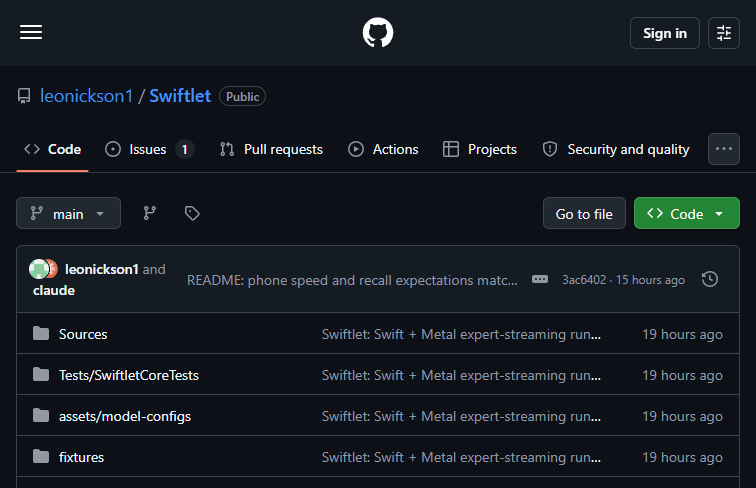
The tool appears to be freely accessible as an open-source project hosted on GitHub.
Summarized from the official site: https://github.com/leonickson1/Swiftlet
Swiftlet is an AI optimization tool that allows you to run large language models like Qwen locally on Apple devices. It is highly memory-efficient, capable of running an 80B model on a Mac and a 35B model on an iPhone.
Yes, Swiftlet is an open-source project. Its repository is publicly hosted on GitHub under the developer name leonickson1.
You can run an 80B parameter Qwen model using only 4.3 GB of RAM on a Mac. Additionally, it supports running a 35B parameter model directly on an iPhone.
A free, self-hosted AI studio with 200+ unfiltered

Objective, community-driven leaderboard for text-t

Optimize and secure AI coding agents with this ope

Generate highly realistic AI images from text with