
A free, self-hosted AI studio with 200+ unfiltered
Open Sourceaivideoimageself-hosted
Free
Video & Animation
Developed by the brilliant minds at Google, Tacotron represents a monumental shift in the landscape of audio and music technology. At its core, it is a fully end-to-end text-to-speech (TTS) synthesis system designed to generate highly natural and human-like speech from written text. Unlike traditional TTS systems that require complex, multi-stage pipelines to stitch together phonemes and sounds, Tacotron streamlines the entire procedure. It operates by mapping characters directly to acoustic features, specifically utilizing Mel spectrogram predictions that can be seamlessly conditioned with models like WaveNet to produce breathtakingly realistic audio results.
What truly sets Tacotron apart from conventional text-to-speech tools is its sophisticated handling of expression. For developers and content creators looking to generate speech for virtual assistants, accessibility tools for the visually impaired, or multilingual applications, the system offers features that go far beyond flat, robotic articulation. Tacotron supports advanced prosody transfer, allowing users to capture and apply expressive emotional styles from one piece of audio to another. Furthermore, its unsupervised style modeling and control grant developers the ability to manipulate the generated speech's tone and rhythm dynamically. This makes it incredibly valuable for projects that require varied emotional contexts or multispeaker TTS synthesis capabilities across different languages.
However, while the output is undeniably impressive, the tool is not without its hurdles. Tacotron is heavily rooted in academic and scientific advancement, backed by extensive Google research and multiple high-profile publications. Consequently, it demands significant computational resources for both the training and inference phases. Implementing, tuning, and optimizing this model for commercial production environments requires a deep understanding of machine learning frameworks and audio processing pipelines. It is not an out-of-the-box software solution for casual users, but rather a robust foundational framework for audio engineers, AI researchers, and developers who have the infrastructure to support heavy workloads. Ultimately, for those willing to navigate its complexities, Tacotron offers an unparalleled ability to synthesize expressive, lifelike voices.
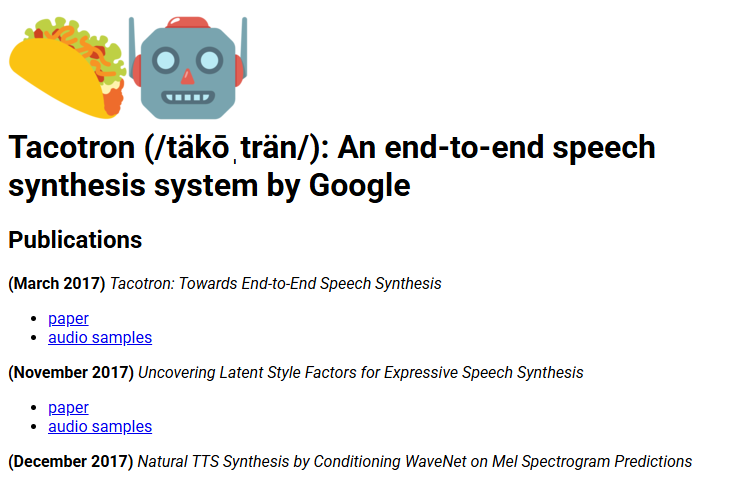 Screenshot
Tacotron is an open-source research project by Google and is free to use.
Summarized from the official site: https://google.github.io/tacotron/
Tacotron is a fully end-to-end text-to-speech (TTS) synthesis system developed by Google to generate highly natural and human-like speech from written text.
Yes, Tacotron is free to use as an open-source research project by Google.
Yes, Tacotron is an open-source research project backed by Google.
No, it is not an out-of-the-box software solution. It requires a deep understanding of machine learning, audio processing pipelines, and significant computational resources to implement and tune.
The main use cases include generating speech for virtual assistants, creating expressive audio content, developing accessibility tools for the visually impaired, and synthesizing voices for multiple speakers in different languages.
A free, self-hosted AI studio with 200+ unfiltered

Objective, community-driven leaderboard for text-t

Optimize and secure AI coding agents with this ope

Generate highly realistic AI images from text with