

A free, self-hosted AI studio with 200+ unfiltered
Open Sourceaivideoimageself-hosted
Free
Video & Animation
For developers and machine learning engineers, fine-tuning large language models (LLMs) has traditionally been a resource-intensive process requiring expensive cloud computing clusters and massive GPU memory. Unsloth is a powerful open-source developer tool designed to completely shatter these hardware barriers. By providing up to 2x faster large language model fine-tuning and significantly reducing VRAM and GPU memory usage, Unsloth allows developers to train custom AI models locally on consumer-grade GPUs. It is a game-changer for rapid prototyping, testing different open-source LLM architectures, and drastically reducing cloud computing costs for large-scale machine learning projects.
So, how does it work? Unsloth utilizes highly optimized low-level programming and custom backend optimizations to streamline the mathematical operations required during model training. Instead of completely overhauling your workflow, it offers seamless integration with Hugging Face and standard training pipelines. This means developers do not have to learn an entirely new framework to reap the benefits. You simply integrate Unsloth into your existing Python scripts, and it immediately goes to work reducing memory overhead and accelerating the training iterations.
Furthermore, the tool boasts broad compatibility with a wide range of state-of-the-art open models. Whether you are working with Gemma, Qwen, DeepSeek, Kimi, or GLM, Unsloth provides the necessary infrastructure to fine-tune these architectures efficiently. Accessible directly via its highly popular GitHub repository rather than a traditional standalone website, the tool is deeply rooted in the open-source community. This makes it an incredibly reliable asset for building domain-specific chatbots for customer support or tailoring foundational models for niche industry applications without paying exorbitant enterprise API fees.
While the benefits of Unsloth are undeniable, it is important to note its primary limitation: accessibility for non-technical users. To utilize this tool effectively, a solid foundation of technical expertise in Python and machine learning is required. It is built specifically for developers, data scientists, and AI researchers who are already comfortable navigating codebases and standard training pipelines. However, for its target audience, the trade-off is more than worth it. Unsloth effectively democratizes the LLM fine-tuning process, offering a completely free solution that empowers creators to push the boundaries of artificial intelligence without being bottlenecked by proprietary cloud platforms or restrictive hardware limitations.
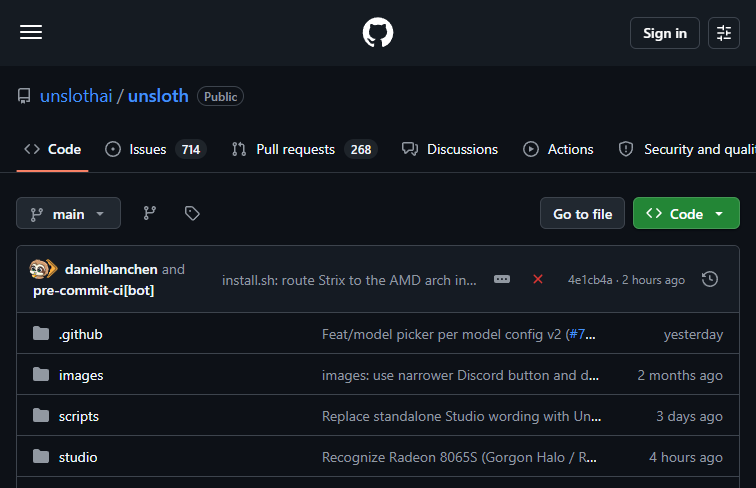 Screenshot
 image
image
 image
image
 image
image
Unsloth is completely free and open-source, distributed under the Apache 2.0 License.
Summarized from the official site: https://github.com/unslothai/unsloth
Yes, Unsloth is a completely free, open-source solution. This allows creators to fine-tune models without being restricted by proprietary cloud platforms or expensive enterprise API fees.
Yes, you can train custom AI models locally using Unsloth. It significantly reduces VRAM and GPU memory usage, allowing developers to run fine-tuning on consumer-grade GPUs instead of expensive cloud clusters.
Yes, Unsloth is compatible with a wide range of state-of-the-art open models. It specifically provides the infrastructure to efficiently fine-tune architectures such as Gemma, Qwen, DeepSeek, Kimi, and GLM.
No, it requires a solid foundation of technical expertise in Python and machine learning. The tool is built specifically for developers, data scientists, and AI researchers who are comfortable navigating codebases and training pipelines.
Yes, Unsloth offers seamless integration with Hugging Face and standard training pipelines. You can easily integrate it into your existing Python scripts without having to learn an entirely new framework.
A free, self-hosted AI studio with 200+ unfiltered

Objective, community-driven leaderboard for text-t

Optimize and secure AI coding agents with this ope

Generate highly realistic AI images from text with