

A free, self-hosted AI studio with 200+ unfiltered
Open Sourceaivideoimageself-hosted
Free
Video & Animation
Developed by Microsoft, VALL-E represents a massive leap forward in the realm of artificial intelligence and zero-shot text-to-speech technology. For podcasters, video creators, and media production professionals, finding the perfect voiceover can be a time-consuming and expensive endeavor. VALL-E aims to completely revolutionize this process by offering a high-fidelity text-to-speech synthesis model that can accurately duplicate a person's voice using a remarkably short three-second audio sample. Unlike traditional text-to-speech platforms that require hours of training data to model a new voice, VALL-E utilizes advanced zero-shot learning capabilities. This means that once the AI analyzes a tiny audio clip, it can immediately begin generating incredibly realistic speech from any provided text.
What makes VALL-E particularly impressive is its unprecedented attention to detail. When it clones a voice, it does not just replicate the basic timbre or pitch. It actively preserves the original speaker's unique emotional tone and even the acoustic environment or background noise present in the initial three-second prompt. Furthermore, the model possesses the capability to generate speech with varied intonations based entirely on the context of the text. This allows the synthesized voice to sound questioning, excited, or stern, making the resulting audio feel incredibly natural and human-like rather than robotic and flat.
The practical use cases for this technology are vast. Content creators can seamlessly generate personalized voiceovers for videos or podcasts without needing to re-record audio. Developers building virtual assistants and chatbots can finally give their digital entities highly natural-sounding voices that carry genuine emotional resonance. Additionally, VALL-E proves highly beneficial for media localization, allowing studios to dub existing content into different voices while maintaining the original performance's emotional weight. It can even be utilized to restore or recreate lost voice audio in media production.
However, VALL-E is not without its drawbacks. Because it can so accurately replicate a person's voice with virtually zero barrier to entry, it raises significant ethical and security concerns. The potential misuse of this tool for generating highly convincing deepfakes or facilitating voice spoofing scams is a critical issue that developers and society will have to carefully navigate. Despite these concerns, VALL-E remains a groundbreaking tool that showcases the incredible potential of modern audio synthesis, offering unparalleled realism for digital audio creators and developers.
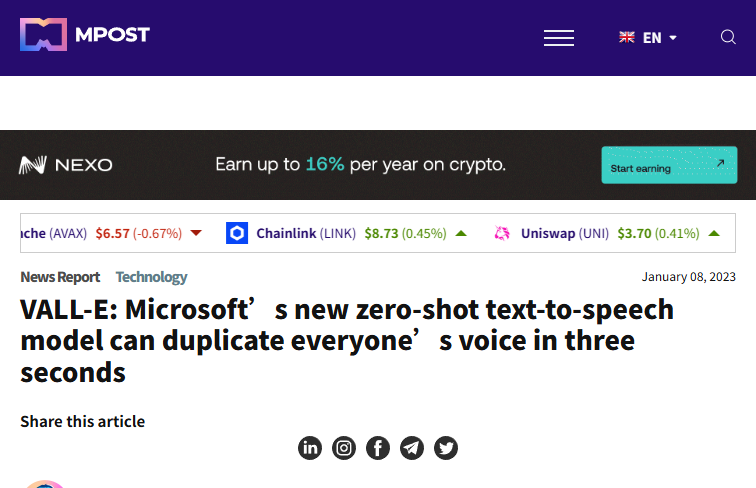 Screenshot
Currently, VALL-E is a research project and model released by Microsoft, with code and data generally available for free to the research community.
Summarized from the official site: https://mpost.io/vall-e-microsofts-new-zero-shot-text-to-speech-model-can-duplicate-everyones-voice-in-three-seconds/
VALL-E is a zero-shot text-to-speech AI model developed by Microsoft that can clone a person's voice using just a three-second audio sample. It generates high-fidelity, realistic speech from any provided text while preserving the original speaker's emotional tone and acoustic environment.
VALL-E only needs a remarkably short three-second audio sample to duplicate a voice. Unlike traditional text-to-speech platforms that require hours of training data, it uses advanced zero-shot learning to immediately generate realistic speech.
You can use VALL-E to generate personalized voiceovers for videos or podcasts, create natural-sounding voices for virtual assistants, and localize media into different voices. Additionally, it can be used by studios to restore or recreate lost voice audio in media production.
Yes, VALL-E raises significant ethical and security concerns because it can accurately replicate voices with virtually zero barrier to entry. There is a critical risk of misuse for generating deepfakes or facilitating voice spoofing scams.
A free, self-hosted AI studio with 200+ unfiltered

Objective, community-driven leaderboard for text-t

Optimize and secure AI coding agents with this ope

Generate highly realistic AI images from text with